






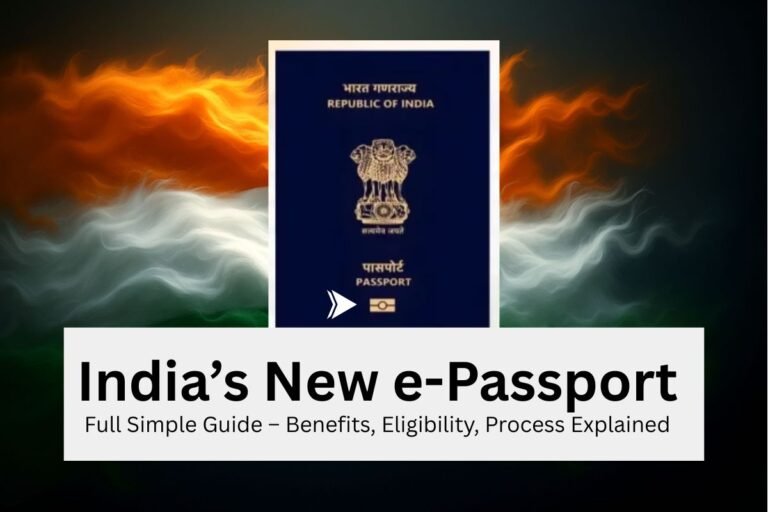
India’s New e-Passport: Full Simple Guide (Benefits, Eligibility, Process Explained)
India is moving very fast toward digital technology, and now another big update has arrived—the new e-Passport. Many people are confused about what exactly this e-passport is, how it works, and whether they should apply for it or wait. Honestly, this guide will clear everything in a very simple and easy-to-understand way.
The government wants to make travel for Indians more secure, smart, and fast, and the e-passport is a major step in that direction. Even though the word “e-Passport” sounds a bit technical and heavy, the real concept is actually very simple.
Top Benefits of the e-Passport (In Simple Words)
Yeh benefits aapko travel aur safety dono me madad karte hain:
1. Much Stronger Security (Huge Positive)
The chip makes the passport almost impossible to duplicate.
This reduces the risk of:
Fake passports
Identity misuse
Illegal copying
For travelers, this is a big relief.
2. Faster Immigration (Big Time Saver)
Many airports around the world have e-gates.
You just scan your passport and walk through—no long lines.
This is super useful for frequent travelers.
3. Global Acceptance (No More Hassles)
Since the e-passport follows international ICAO standards, it works smoothly worldwide.
Immigration officers scan it quickly, and processing becomes easier.
4. Part of India’s Digital Upgrade
The government is modernizing travel systems.
This new passport is a positive sign that India is moving toward smart travel technology.
It’s actually a proud moment because many developed countries use this system already.
Who Can Apply for an e-Passport?
The best part?
Anyone who can get a normal passport can apply for the e-passport too.
Right now, e-passports are available only in selected Passport Seva Kendras (PSKs) and Post Office Passport Seva Kendras (POPSKs).
Soon, it will be launched all over India.
Before applying, just check whether your nearest center has started issuing e-passports.
Step-by-Step Process to Apply for an e-Passport
Actually, the procedure is almost the same as a regular passport.
Nothing confusing here.
Step 1: Register on the Passport Seva Website
Go to the official Passport Seva portal and create an account.
If you already have one, just log in.
Step 2: Fill the Application Form Carefully
Fill your personal details honestly.
Even a small mistake can delay the process, so better to check once again.
Step 3: Pay the Required Fee
Fees are almost the same as a normal passport.
Payment can be done online.
Step 4: Book an Appointment
Choose the nearest PSK or POPSK and book your date and time.
Step 5: Visit the Center for Biometrics
This is important.
They will capture:
Your fingerprints
Your photograph
These details go inside the chip of your new e-passport.
Step 6: Verification and Dispatch
Once police verification (if required) and document checks are completed, your passport will be printed and delivered to your home.
Why e-Passport Is a Game-Changer (Positive + Negative Points)
Positive Points (Power Words)
Ultra-secure
Faster than old systems
Smart international travel
Trustworthy technology
Future-ready
Modern design
Negative Points (Still Important to Know)
Not available in every city yet
Some people may face technical confusion
Few centers may delay the rollout
But overall, the positives are much more stronger.
Final Thoughts (Human-Style Conclusion)
To be honest, the e-passport is a big improvement for Indian travelers.
It’s safer, faster, and actually feels modern.
It may take some time before it reaches every city, but once it does, traveling will become much smoother for everyone.
If you’re planning to apply for a new passport or renew the old one, going for an e-Passport is definitely a smart decision.
Travel is changing, the world is changing, and India is finally catching up with global travel standards.
This is the right time to go digital and stay future-ready.